Two decades of governed content. One live AI production system.
I have spent 20+ years building content that survives audit: payer benefits, decentralized clinical trials, behavioral health, member communications. For the past 18 months I have also run a one-person media R&D practice, Pearl Soleil Studio, where I built and operate a governed AI content production system end to end.
The two bodies of work answer each other. The enterprise work is where the standards come from: plain language for real health literacy levels, accessibility conformance, voice systems, taxonomy. The lab is where those standards became executable: encoded into an AI production pipeline that ships daily, with governance running as controls rather than as documentation.
Everything below shipped. Nothing is a mockup or a spec.
Current work · Pearl Soleil Studio · 2024–present
The lab: a governed AI content system, run in production
Pearl Soleil Studio is an independent contemplative wellness media brand serving adults who live with chronic illness, isolation, and anxiety. I built every layer alone: the audience research, the AI production pipeline, the governance controls, and the engagement instrumentation. The three case studies below are three views of one system.
Case study · Population health
Calm media for an unreached population
Context
Older adults managing chronic illness, pain, and isolation are a priority population in every health plan's strategy. They are also on TikTok, where health systems rarely reach them. Conventional health messaging does not land there, and content built for capture actively costs this audience regulation.
Approach
Audience research from primary signals. Personas built from observed viewer states: profile analysis, comment corpora, follower demographics, and share behavior. Not assumptions imported from a brief.
Register design. Second person, present tense, mirroring the viewer's state without naming it. Health literacy principles throughout: plain language, one idea per line, low cognitive load.
Intervention format. 30-second to 2.5-minute contemplative clips designed to downshift arousal rather than spike it, on the platform the population already uses daily.
Results (28-day platform export, Jul 9 – Aug 5, 2026)
19.5%
Engagement rate on 14,570 views, vs. a 3–5% platform norm
518
Comments in 28 days, mostly unsolicited first-person reports of felt calm and connection
~2%
Of viewers share, unprompted: the content functions as peer-to-peer support media
Why this matters
Behavior change starts with attention that does not cost the viewer their regulation. The standing objection is that calm content kills metrics. This project answers the objection with data: calm design and high engagement coexist, measured on the most attention-hostile platform there is.
Case study · Governed AI production
A production architecture where governance is the runtime
Context
Seven posts per week across two platforms, produced by one person, with zero tolerance for brand drift. That constraint forced an architecture. The same architecture is what regulated organizations need before they can deploy generative AI in content production at all.
The system
Intake. A structured field-notes format captures source material in batches, so production starts from consistent, reviewable input instead of ad hoc prompts.
Copy engine. An encoded voice standard runs as an executable control: register rules, controlled vocabulary, ban lists, and a rotation system that varies each clip's opening line by target viewer state. Copy that violates the standard does not ship.
Asset generation. Leonardo.ai with character-reference locking for visual brand consistency across hundreds of assets. Kling for motion. Audio is selected by ear against the brand standard: live-recorded djembe for the calmer pieces, licensed platform audio where distribution evidence supports it. Tool choices follow evidence, not ideology.
Assembly. CapCut and Canva against fixed templates, so editing is execution, not re-decision.
Publish and instrument. Every clip enters the measurement loop described in the next case study. Output feeds diagnosis; diagnosis feeds the standard.
The governance thesis
Before AI, style guides and audit artifacts were static documentation that humans consulted, or ignored. In this system they run as the production runtime: the voice standard, quality gates, and vocabulary controls execute against every asset before it ships. Materials are versioned and re-released like software.
Operational proof: a sustained 7x/week cadence held by a single operator, with tool decisions revisited on evidence. Vendors rotate in and out as capabilities change. The standard stays fixed; the tools rotate.
The transfer
Swap the voice standard for a payer's brand and compliance requirements, swap the ban list for regulatory language controls, and this is the deployment pattern for governed generative AI in regulated content: controls that execute, not PDFs that advise.
Case study · Engagement instrumentation
Instrument, isolate, intervene, measure
Context
Early on, committed viewers finished the clips but audience growth stayed flat. The question was not how to make better content. It was where, precisely, attention leaked.
Diagnosis one: the entry, not the body
Retention analysis isolated the failure to the first two seconds. Under 30% of viewers remained at 10 seconds and about 15% at 30 seconds. Then the curve went flat: viewers who survived the entry stayed to completion. The cliff is the entry, not the body. Length and content were exonerated.
Per-clip retention shape, TikTok Studio analytics. The drop concentrates in the entry; the body of the clip retains.
Intervention
First frame rebuilt. A face and the opening line of the piece itself, replacing ad-style imagery. The face is AI-generated and deliberately crafted: over 10,000 image generations to hold a brand-consistent character the base models resist producing, an older woman rendered as beautiful. The most-watched frame became presence plus content, not an ad for the content.
Sixteen tested opening overlays, rotated by target viewer state, so each clip in a batch opens a different door for a different arriving state.
Door and Room copy framework. The opening speaks the viewer's own language; the body resolves in the brand's voice. Entry matches the viewer; the experience stays on-brand.
Measured effect
160 → 606
Average daily views before vs. after the first-frame intervention (Jun 27 – Jul 24, 2026 export)
0.8% → 3.1%
Share rate across the same window
19.5%
Engagement rate sustained across the most recent 28-day export
Diagnosis two: the funnel moves
Post-intervention funnel analysis: roughly 20% of viewers engage and 2% share, but only 1.5% visit the profile. The constraint migrated from the entry to the feed-to-profile step. That is the loop working as designed: each diagnostic retires one bottleneck and exposes the next.
Scale note
These are single-operator numbers, not enterprise scale, and they are reported as such. What transfers is the loop: instrument, isolate the constraint, intervene, measure again. The method is the deliverable, and it runs the same way on a member-communications program as it does on a media channel.
Enterprise work · 2012–2024
Where the standards come from
Payer systems, decentralized clinical trials, and member-facing health content. This is the regulated-environment foundation the lab work sits on: research-driven, standards-first, built to survive audit.
ZS Associates | Medullan · Digital & Connected Health · Senior UX Content Strategist · 2021–2024
Decentralized clinical trials and a content practice built from zero
Context
Global consulting firm, digital and connected health capability. Clients included startups, research institutes, and pharmaceutical companies. I was brought in to establish an outcomes-driven content practice and to lead content for decentralized clinical trial platforms.
Decentralized clinical trials
For a DCT platform refresh I developed the information architecture, content modeling, pattern library, and accessibility standards, with plain language and health literacy applied to the hardest content in the product: eligibility screening, privacy, and informed consent.
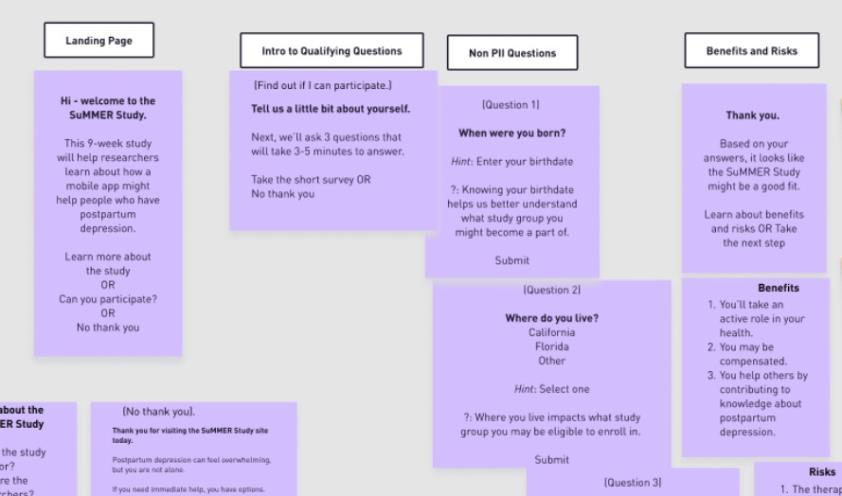
Initial IA for the trial participant journey: landing, eligibility, benefits and risks, consent. Every branch, including "no thank you," gets designed content.
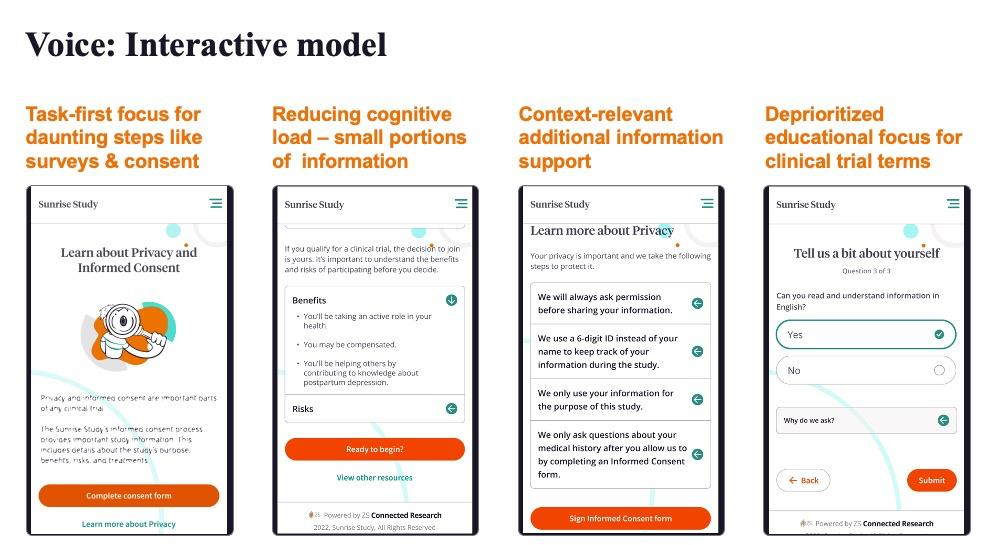
The voice system treated conversation types as design objects: task-first focus for daunting steps like surveys and consent, small portions of information to reduce cognitive load, context-relevant support, and a deliberately deprioritized educational register for clinical trial terminology.
The interactive voice model applied to trial screens: consent, privacy, and eligibility written for real health literacy levels.
Practice building
Alongside project work: a data-driven content strategy framework socialized into RFPs and all digital solutions work, health literacy and accessibility standards training, thought leadership including a white paper on digital healthcare, and an explainer script for a prescription digital therapeutic's distribution pathway.
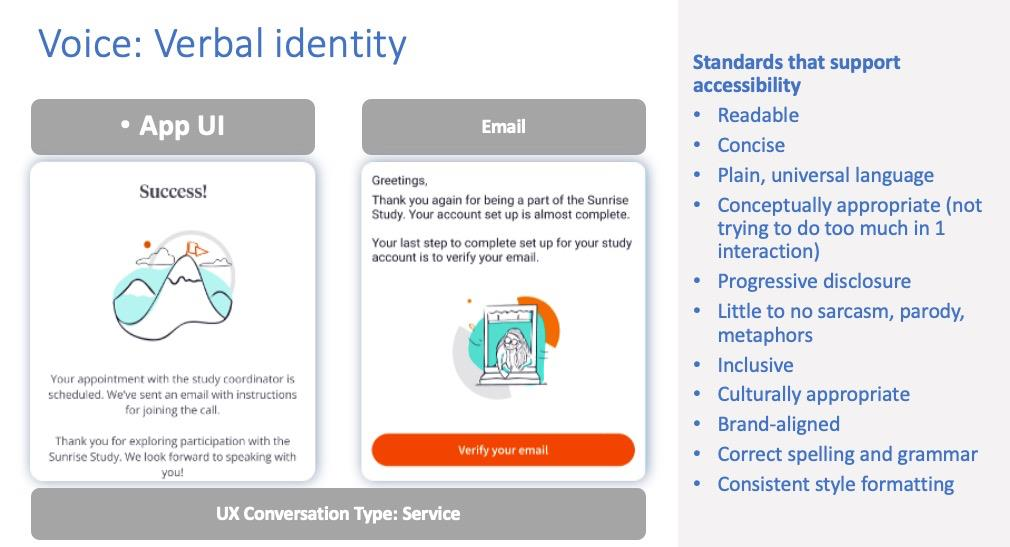
Verbal identity standards: the checklist that made accessibility a property of the voice system, not an afterthought.
Blue Cross Blue Shield of NC · Non-profit health payer · Digital Content Strategist
Sixteen features of continuously delivered content for a payer service platform
Context
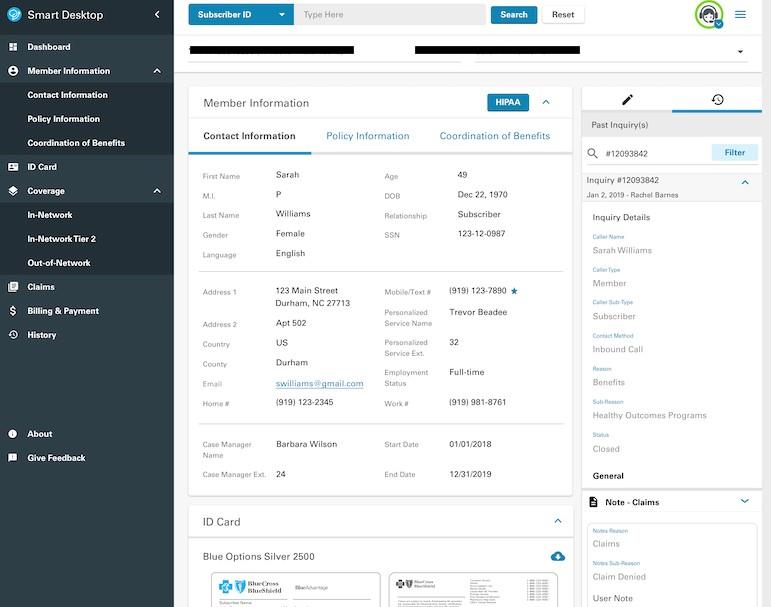
Smart Desktop: an omni-channel, customer-service-facing single pane of glass for member information, claims, benefits, and billing. Content for 16 features, delivered continuously in Agile.
Method
Research the feature topic through system documentation and key informant interviews; analyze findings through qualitative data analysis; develop and document content; test through deployed surveys and user interviews; refine, validate, and deliver to Confluence. Repeat, per feature, on cadence.
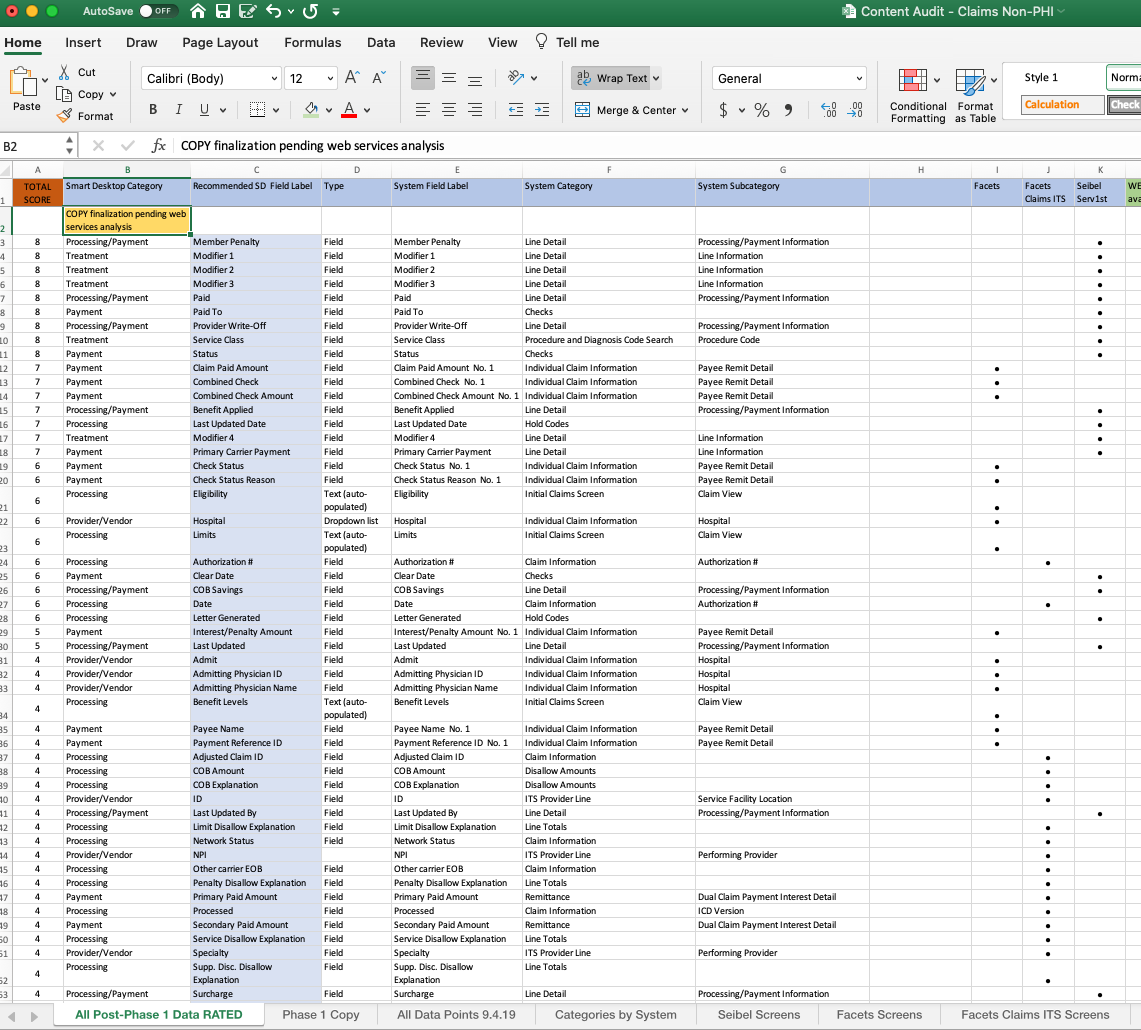
Smart Desktop: one screen replacing swivel-chair navigation across member systems.The core model behind the screens: taxonomy, metadata, and field-label decisions scored and traceable.
The unglamorous artifact matters most here. Every label on the screen traces to a scored decision in the model. That traceability is what makes content in a payer environment defensible.
Orthus Health · Employee wellness vendor · Curriculum Engineer and Behavioral Content Consultant
Member content overhaul and a behavioral program built from theory
Context
Startup wellness vendor with member-facing content that underperformed on engagement and health literacy. Scope: assess and revise all member-facing content, then design a digital stress management program from curriculum through copy.
Work
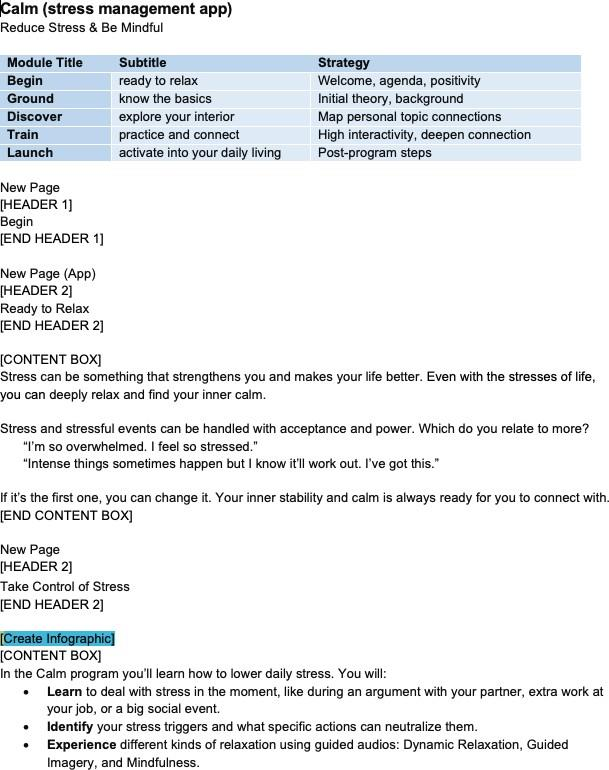
Phase 1 revised the member web portal, health analytics reports, and health action reports for plain language, warmth, and engagement. Phase 2 delivered the stress management program: five modules moving from welcome through theory, exploration, practice, and post-program activation, with copy and design mockups delivered pre-UX/Dev.
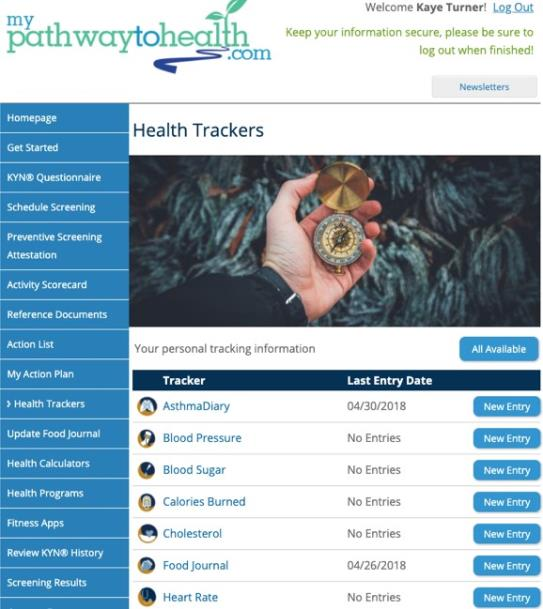
Member portal after revision: trackers with guidance written to be acted on, not just read.The stress program POC: curriculum architecture and copy delivered in a structured content model, ready for design and build.
Behavior-change theory drove the module arc; the content model made the curriculum buildable by a team that had never shipped one.
Experience
Timeline and domains
2024–present
Pearl Soleil Studio · Senior Content Designer, independent. Governed AI content production system, run solo in production.
2021–2024
ZS Associates | Medullan · Senior UX Content Strategist, digital and connected health.
2021
Climate Corporation / Bayer · Senior Content Strategist. The one non-health domain: cross-domain portability proof.
2012–2024
Integral Wellness Content Design · Independent health content practice, concurrent. Clients included Blue Cross Blue Shield of NC and Orthus Health.
Medicare & MedicaidPayer benefitsDigital healthDecentralized clinical trialsBehavioral healthPopulation health
Working standard
This site holds itself to the same standard
Calm by Design is the review standard I apply to content in regulated and health-adjacent contexts. Three pillars, and this page is scored against them.
Understandability
Plain language throughout. Short sentences, one idea per line, no jargon a hiring manager or a member would have to look up.
Accessibility
Semantic structure, skip link, visible keyboard focus, alt text on every image, reduced-motion respected, WCAG-level contrast.
Attention integrity
No popups, no autoplay, no urgency mechanics, nothing that moves without being asked. You leave when you are done.